Survive the next event
Match your action to the event, not to the last round. A knife prompt asks for a reaction. A wire manual asks for interpretation. A gun or vote asks you to choose within a different set of rules. Identify which decision is actually yours before spending attention on a card or another player.

Official promotional artwork: ARK-ADE / Roblox. Event names and descriptions below follow the community event reference; the prompt in your live round takes priority if a rotation changes.
Find the decision in front of you
| What the event shows | Your first check | Detailed help |
|---|---|---|
| A dodge choice | Locate the correct button and react | Knife Toss below |
| A numbered wire manual | Read the complete instruction | Bomb defusal |
| A bomb being passed | Identify the passing action | Time Bomb below |
| A player-selection prompt | Check your role and the timer | Guns and laser pointers below |
| Card choices or a card in your hand | Distinguish choosing, holding and activating | Card guide |
| Spare, eliminate or two named candidates | Read what your vote means | Voting below |
| A split or steal choice | Check the consequence of your own choice | Split or Steal below |
Knife Toss: react to the label, not the animation
The community description calls Knife Toss a quick-time event. It distinguishes the dodge choice from a die choice. The actionable habit is to find the label you need, rather than click whichever button appears closest to the centre of the screen.
Keep the pointer or your tapping finger ready to select the intended control. Do not assume the animation itself is the clickable target. If you fail while concentrating on the clown, redirect your attention to the prompt the next time the event appears. The visual threat and the control you need can occupy different places.
Treat this as a recognition problem before treating it as a speed problem. Repeatedly clicking the wrong label faster will not solve it. A short mental instruction such as “read dodge, select dodge” is more useful than reacting to the colour of a button you have not checked.
The screenshot or device layout you remember may not match your current screen. On a smaller display, keep the prompt unobscured by another menu. If you record a failed attempt, check whether the input was late, on the wrong label or outside the target. Those are different mistakes, and each needs a different adjustment.
Revolver and laser pointer: identify who must choose
In player-selection events, establish your role first. Are you the player who has received the choice, a potential target, or someone waiting for the result? Advice about aiming or choosing is useful only when the interface gives that action to you.
The timeout consequence depends on the variant. In Revolver with music, failing to choose makes the clown shoot the gun holder. In Revolver without music, the gun targets a random player instead. In Laser Pointer, a timeout makes the clown choose a random target. These descriptions allow the gun to jam or fire; selection is not a guaranteed kill. Information gathering must fit inside the decision window.
If you have information about another player's cards, focus it on a decision you can legally make. For example, compare two plausible targets rather than trying to understand every seat at the table. A complete inspection that finishes after the prompt closes has not helped the current turn.
Do not present target selection as a guaranteed elimination. A chosen action and its resolved outcome are separate things. The game combines chance with card effects, and the official description explicitly frames play as luck and strategy. Make a useful choice without promising yourself that every shot will behave identically.
A useful target-check sequence
- Read the event's selection instruction.
- Check that you are the player permitted to act.
- Inspect relevant visible effects if you can do so in time.
- Select within the allowed interface.
- Watch the result before deciding what your card or target choice actually changed.
This sequence is a recommendation for managing attention. It is not a hidden game formula or a claim about targeting odds. It helps separate what you control from what the round resolves afterwards.
Duel: stop importing ordinary-round protection
The community event list explicitly notes a Blank exception for Duels. The printed Blank example also excludes PVP events. That makes “I still have Blank, so a shot cannot matter” an unsafe assumption when the task has changed into a player-versus-player event.
Read the duel prompt as a new rule context. Consider the required input and the visible timer before checking a defensive effect. If both players are under a deadline, waiting for an ordinary table event to resolve is not the same as responding to the duel itself.
When reviewing a loss, record the event name alongside the card. “Blank did not work” leaves out the condition that may explain it. “Blank was held during a Duel” is a much more precise comparison with the printed exception. The same habit applies whenever a card description limits its effect to a particular attack.
Do not infer that one exception disables every card in PVP. Check each card separately. An excluded bullet effect is evidence about that effect; it does not automatically establish a rule for information cards, all protection or every future duel variant.
Bomb Defusal: interpret, then select
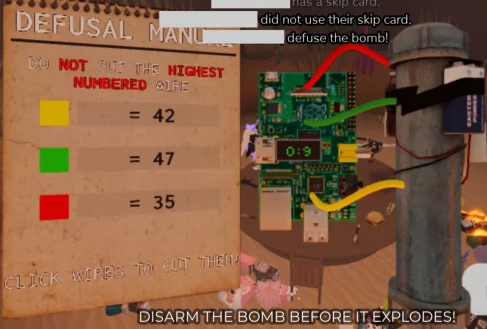
The manual-and-wire event is best handled as a reading task. First identify what the manual permits or forbids. Then associate each value with the correct colour. Only after that should you select the intended wire targets.
The dedicated bomb guide includes an actual manual and a practice exercise. In that example, the highest number is the protected choice. The useful lesson is preserving the instruction's meaning, especially a negative word, rather than memorising the pictured colour.
Keep this task separate from the game's other bomb events. A video of passing an explosive does not explain which wire to cut. A player telling you to “send it to someone” may be answering a different event. Describe the manual you see when requesting help.
If the prompt is obscured, avoid inventing a rule from partial text. Readable information is the basis for the answer. This guide cannot supply a missing instruction by estimating which colour appears safest, and it does not claim that a protective card makes every wrong cut harmless.
Time Bomb: look for the passing action
The community reference describes Time Bomb as a passing event with an uncertain detonation time. That uncertainty changes the useful question. You are not solving the colour comparison from Bomb Defusal; you need to recognise the current passing instruction and the action available to you.
Do not turn uncertainty into a claimed countdown strategy. A player who survived after holding the bomb for a particular interval has shown one outcome, not established a repeatable safe duration. Likewise, a clip ending just before an explosion is not proof that the same delay works in the next match.
When practising recognition, pause a recorded round and identify who is currently holding the bomb, what input is shown, and whether you are the person who must act. This makes the distinction between watching a bomb and being responsible for passing it much clearer.
If your input appears not to work, check the event and role before concluding that the game ignored you. An action can be unavailable because the bomb is not currently yours. Input latency and a missed target are also possible, but a single lost round cannot isolate which explanation is correct.
Bomb button: understand the local constraint
Bomb button is another separate entry in the community event list. It involves a button and a continue-or-pass decision. Do not use the wire manual answer for it, and do not assume every passing event has exactly the same input.
The community description says the player must press the button, then choose whether to keep pressing or pass it right. Each recipient must press at least as many times as the button has been passed. This is a minimum-input constraint, not permission to pass immediately every time. Check the current requirement before deciding to continue; the wire manual answers a different problem.
If you are discussing the event after a match, specify whether you saw a button, a wire manual or an explosive being passed. That description helps other players answer the actual question and keeps an apparently contradictory tip from becoming a false universal rule.
Card events: separate the choice from the card
Receiving a card, selecting a card and using a card are different moments. A card-selection prompt asks you to choose among the displayed options. A later Activation card may then ask you to choose a recipient. The second decision does not disappear simply because you made the first one correctly.
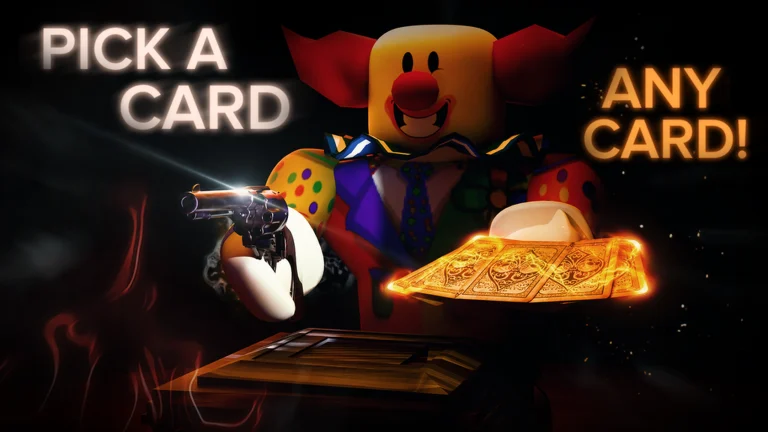
Choose a Card offers three cards and lets you keep one. Free Card gives a random card without that selection. Pick a Card is a different five-card event: the community reference describes one fatal shotgun result, one jammed-shotgun result and three obtainable-card results. Do not confuse the safe-sounding name with the three-option selection event.
Card Risk offers a positive card in exchange for a shooting risk. The community reference reports that risk as one in three; that is a community-described rule, not independently measured current odds. Consider the offered benefit and your survival goal. A positive label does not remove the risk attached to obtaining the card, and accepting every offer is not a guaranteed winning strategy.
After the event, inspect the hand again. New information is most useful before a fast prompt arrives. If you discover an Activation card only while another event is already demanding input, you have added a reading task at a difficult moment. The card guide explains the three usage labels.
Split or Steal: decide using the actual payoff
The community reference gives three outcomes. If both players split, each receives a card. If one steals while the other splits, the thief receives the other player's cards plus one new card. If both steal, nothing happens. This makes your starting hand and the other player's choice relevant: the decision is not simply which button grants an extra card.
You cannot know another player's selection merely because they made a promise. A strategy that depends on their cooperation should acknowledge that dependence. Similarly, a past betrayal does not prove every future opponent will make the same choice.
Separate an explanation of the outcome from advice about what you should choose. An outcome table can describe the rule; choosing between cooperation and stealing requires an assumption about the other player and your priorities. This guide does not manufacture a winning probability for either option.
Spare or Eliminate: read the vote's direction
Some voting prompts ask whether a selected player should be spared or eliminated. Another prompt can ask you to select between candidates. Before clicking, establish whether the control expresses a player choice or a survival decision. The same seat does not always mean the same thing.
In ordinary Spare/Eliminate, the community description allows living and dead players to vote, with counts shown during the decision. In Eliminate/Spare Secret, dead players cannot vote and choices are revealed after time runs out. Do not assume a spectator can participate in every vote. If no voting control appears, check the event's eligibility before searching for a hidden button.
Avoid confusing displayed support with a locked outcome. A visible count is information about the current vote; it does not establish what every remaining player will do. Where the interface permits a choice, make the choice that expresses your intention, rather than clicking a label you only recognise from another vote.
Multi-Vote: check who your click protects
A two-candidate vote deserves particular care because the direction matters. In the community description of Multi-Vote, players vote for the person they want to spare; the candidate with fewer votes is eliminated. Selecting a dangerous opponent's name can therefore help that opponent survive. Read the current prompt before selecting a name, and do not assume a tie rule that the reference does not specify.
If your intention is to remove a dangerous player, a vote to spare that player's name would express the opposite intention. This is another example of a reading error that faster clicking cannot solve. First translate your goal into the actual meaning of the control.
Card information can inform whom you would prefer to survive, but it does not change the label's meaning. A useful question is “which name represents the outcome I want?” rather than “which player do I dislike?” The second question skips the step that connects your intention to the event's input.
Chained: account for linked consequences
The Chained event links two players and gives them the Chained card. The community reference describes a high chance of the linked player also dying when one is eliminated, rather than an unconditional guarantee. Inspect the displayed link before treating another player's elimination as irrelevant to your own survival.
Do not invent an exact probability from the word “linked.” If a source describes a chance rather than a certainty, preserve that distinction. A link can affect how you evaluate a target without giving you a guaranteed prediction of the final result.
When a chain changes the situation, reconsider your original goal. An opponent you would ordinarily want removed may have become connected to your own survival. A recommendation based on the earlier board should be re-evaluated when the board changes, rather than followed simply because it was sensible one turn ago.
Life Saver: follow the safety status, not only the pointer
In Life Saver, the green pointer's holder chooses someone to save, and the pointer passes to that saved player. The sequence continues until half the living players are safe, rounding upward. The clown then eliminates one random unsaved player. The original holder is not safe by default. With seven living players, the described rounding makes four safe; it does not eliminate all three remaining players.
The useful reading routine is to identify your role, identify who is marked safe, and then make the choice available to you. A previous selection and a current safety state are different pieces of information. Do not let the animation obscure which one affects your next decision.
If you are learning the event through a clip, follow a single player across the sequence and watch the safety indicator. This is easier than trying to track every selection at once. It also exposes why “they touched the pointer” is not always a sufficient explanation of who survived.
Fire and saw prompts: focus on the active control
In Fire Breathing, a selected player repeatedly clicks a moving button to extinguish the fire before time expires. In Multi-Saw, two players compete: pressing your button slows your saw and speeds the opponent's saw. A critical button may appear and is described as more effective. Follow the actual control, and switch attention to the critical option when it appears rather than substituting a card click for the timed task.
For a moving control, follow its current position instead of continuing to tap where it first appeared. For any repeated-input task, confirm the action indicated by the interface rather than assuming holding and clicking are interchangeable. This guide does not invent a required clicks-per-second target.
If you have trouble, separate recognition from execution. Was the correct control located? Did the input method match the prompt? Did your attention leave the task while you checked another part of the interface? Reviewing those questions is more useful than attributing every failure to insufficient speed.
Game modes change the context
The game-mode reference lists ordinary, seasonal and special modes. A mode can change the surrounding pattern of play even when an individual event name is familiar. Read the voted mode before applying a strategy from a different match.
In a mode described as giving extra cards, allocate attention to the changed hand. More cards can mean more reading and more possible triggers. That does not make every card a manual ability or remove the need to complete a timed event.
In a mode described as involving teams, inspect your team context before choosing targets. Do not assume that everyone at the table is an opponent in the same sense as an ordinary free-for-all. A recommendation to target a visible threat should account for whatever team rule the current interface establishes.
Special events may require an administrator or content creator. A clip showing an unusual event is not proof that you can summon it from the normal mode vote. If you want ordinary play, learn ordinary prompts first and treat special footage as a different context.
A protection checklist before a dangerous event
| Check | Why it matters |
|---|---|
| Printed effect | Establishes what the card actually changes |
| Usage type | Separates deliberate use from automatic or passive behaviour |
| Duration | Avoids planning around an effect that is expiring |
| Event exception | Prevents ordinary-round advice being carried into an excluded situation |
| Current recipient | Avoids confusing a granted effect with your own protection |
Apply this checklist before declaring an outcome impossible. “I had a good card” leaves four of those checks unanswered. Good information lets you narrow an explanation; a vague tier label does not.
There is also a distinction between preventing an event's input mistake and surviving its consequence. Learning to read a wire manual solves one task. A claim about a card overriding a failed defusal would require separate evidence. Do not join those claims simply because both involve survival.
Review a failed round without inventing a rule
Start with what was visible: the event name, the prompt, your card text, the input you made and the resolved result. Then identify the smallest explanation that fits. A missed negative word needs a reading correction; an expired card needs a duration check; an excluded event needs the correct scope.
Your next-match routine
Before the round, identify the mode. When the hand changes, read the usage labels and timers. When the event begins, reduce it to the action it asks of you. After it resolves, compare the result with the prompt and the relevant card text.
This routine does not turn a game of chance into a guaranteed win. It aims to remove preventable reading and input mistakes while leaving random outcomes honestly random. For the underlying event descriptions, see the community reference. For the hand itself, continue to cards and timing.